
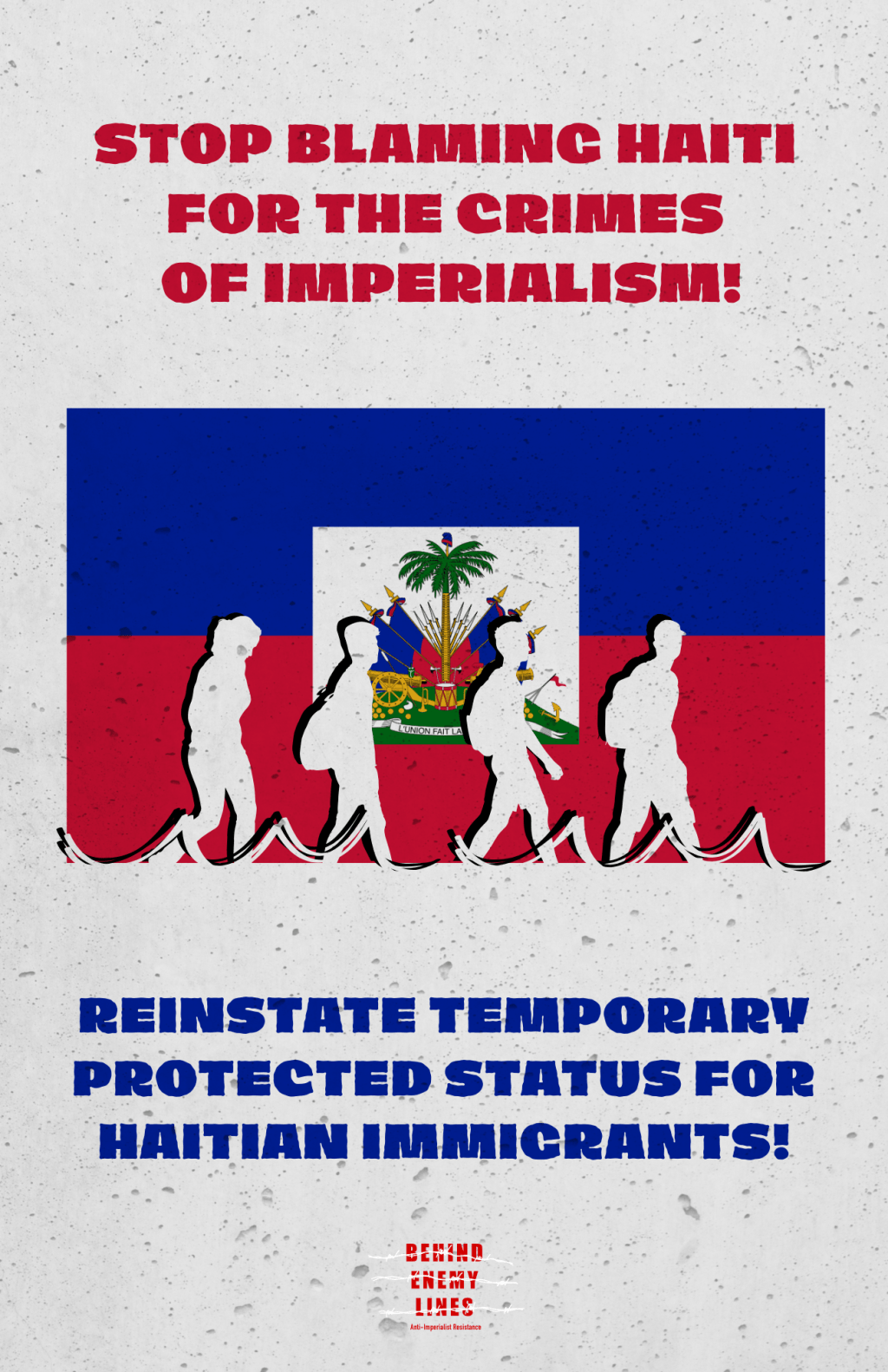
National Day of Agitation: Saturday, February 28th
The United States government continues its war against immigrants and against the Global South with an attempt to overturn Temporary Protected Status (TPS) for Haitian immigrants. TPS, intended to be a legal protection for immigrants from countries like Haiti facing armed conflict and natural disaster, gives immigrants protection from deportation and provides some security in employment. The Trump administration wants to get rid of this status, likely in preparation for making Haitians the new target for a broad-scale campaign of terror, arrest, and deportation against Haitian communities.
Haiti has faced centuries of the most brutal slavery, exploitation, and colonial and neo-colonial domination by first Spain, then France, then the United States of America. The land of the first successful slave revolt to win national liberation, Haiti was then saddled by immense debts to France, occupied by both France and the United States, suffered under US-backed anticommunist dictators, and faces rampant extreme poverty and terror by organized gangs. Throughout all of this, the United States bourgeoisie and its lackeys have spun racist myths about the country to suit its imperialist agenda. Open white nationalists in government and the news try to draw red strings between Haiti’s current dire state and its inception from an armed Black revolution. Baseless shock propaganda about Haitian immigrants in Ohio eating people’s pets are still taken as gospel fact, spread in major news organs and on social media by a thoroughly cross-class coalition of white Americans across the country. At the same time, the slightly more covert white supremacists in the Democratic Party imply that the current crisis can be solved by United States intervention, rather than being caused by it.
Now, building on a growing wave of anti-migrant rhetoric that the bourgeoisie uses to stir up the broad white supremacist swathes of this country behind President Trump, Secretary of Homeland Security Kristi Noem is attempting to end Temporary Protected Status for Haitian immigrants. TPS is designated to countries facing ongoing armed conflict, natural disasters, and other “extraordinary and temporary conditions”. It prohibits, among other things, the deportation of immigrants back to their country of origin and allows for temporary work authorization. Haiti is not at risk of losing its TPS because the ever-present gang violence has died down, nor has the country recovered from devastating hurricanes in the last decade. Rather, Noem and her DHS goons are cracking down on Haitian immigrants to court popularity among the growing sections of society who wish to return to the “land of the free white”, reinforcing imperialism at home and abroad as they do so.
We call on the people across the country to reject these racist lies about Haitians in Haiti and in the US and fight back against the attempted overturning of Haiti’s TPS!
Liberté. Égalité. Por Qui?
Liberty. Equality. For who? From the first time Europeans set foot in Haiti, with Columbus’s invasion in 1492, the history of the island of Hispaniola (now Haiti and the Dominican Republic) has been a story of the most brutal oppression. Spanish settlers forced the native Taino people to work under the encomienda system, forced labor in plantations and mines until 1697, when the French and Spanish divided the island up between them, and Haiti was formed as a massive slave colony. The French established coffee, sugar, and tropical fruit plantations, and kidnapped and enslaved hundreds of thousands of Africans to work the plantations.
French slavers in Haiti imposed some of the most brutal conditions of the entire African slave trade. The island’s population in 1788, just a few years before the revolution, was 25,000 Europeans, 22,000 free (but disenfranchised) people of African and Taino descent, and 700,000 enslaved Africans. Such a vast number of slaves was necessary because nearly 1 in every 3 enslaved people died within several years on the plantations. The total disregard for the lives of the enslaved people, the brutality administered by the owners of the plantations, and the great number of slaves kidnapped and brought to the island made Haiti extremely profitable, growing primarily coffee, fruit, and sugar for Europe. The plantations there generated generated 40% of French foreign trade and produced more wealth than double that of all of England’s colonies combined.
In 1789, the French Revolution overthrew the crown and promised “liberte, egalite, fraternite”, universal rights for man. Two years later, on August 22, 1791, thousands of Haitian slaves rose up and killed the slavemasters and other whites living on the plantations. Over the following months, the rebels united into an army over 100,000 strong, and by 1792, they had liberated the slaves and established control and freedom over a third of Haitian land. The ostensibly “revolutionary French” government first fought back, authorizing French-Haitian slavers and French soldiers to try to crush the rebellion, then tried to pacify the Haitian people by establishing legal equality for free Black and Taino Haitians (but not the large majority still enslaved). Ultimately, though, the revolution was successful, and the French were forced to sign into law the abolition of slavery in Haiti. Toussaint Louverture, a former slave and a general during the revolution, assumed leadership, and in 1801, wrote a constitution that established Haiti as a Black nation with Black leadership and total abolition of slavery. Where the French spoke abstractly about the universal rights of mankind, they fought back against it viciously when it meant a threat to their colonialist interests and to white settler rule. Enlightenment principles about liberty and individual rights, which were revolutionary in comparison to a colonial slave economy, were granted to Black slaves in Haiti only when they were won by revolutionary war (and no small amount of post-war violence, entirely justified, against the former slavers and their children).
“Failed State” or Casualty of Imperialism?
After the revolution, Haiti found itself still attacked from all sides by imperialist, capitalist, and colonialist powers. In the two centuries after its liberation, Haiti faced crushing debt to France, occupation by the United States and other ostensible “peacekeeping” forces, and conflict with and massacre by its somewhat more powerful (though still oppressed by imperialism) neighbor, the Dominican Republic. When people attempting to understand conditions in Haiti today try to imply that the poverty and violence are somehow Haiti’s fault, they ignore the most obvious historical fact – that Haiti has, ever since winning independence, been besieged from all sides and prevented from any meaningful amount of national development.
Twenty-one years after the revolution kicked out whitey (if whitey was lucky), French warships docked on the shores. In exchange for de jure recognition of Haitian independence and the end to slavery, France decreed that Haiti would have to make annual payments to the crown in recompense for lost property. The debt, which totaled 150 million francs, was in part a perverse sort of “reparations” for the slavemaster rather than the slave. To be sure, had the French just been talking about coffee, sugar, or land, they would not be the slightest bit more entitled to repayment, since all of the aforementioned had been stolen or paid for by the blood of the Haitians. But what was actually being charged as “stolen property” were the Haitian people themselves. After getting their asses thoroughly kicked, French slavers felt slighted not just by defeat, but by the fact that the people they had been working to death were no longer legally their property.
Obviously, Haiti did not have 150 million francs lying around, since it had just fought a brutal civil war for liberation from chattel slavery. In order to make their first payment of 30 million francs, they were forced to take out high-interest loans from France, creating a self-perpetuating “double debt” that hung over the country until 1947, over a hundred years later. France went through myriad changes in government during this time, but all the governments with their different political tendencies continued to mandate debt payments. This debt destabilized Haiti’s banking system, and was used in 1914 as justification for a seizure by the United States of Haiti’s entire gold reserve, occupation by U.S. troops, and designation of 40% of Haiti’s entire national income to be paid to France and the U.S. This debt held Haiti back from the sort of meaningful development that was seen in the Dominican Republic and Jamaica, and is recognized by historians as the basis of Haiti’s extreme food insecurity.
The people of Haiti did not just face oppression from imperialist powers, though. In the neighboring Dominican Republic, another country oppressed by imperialism but with a lesser legacy of chattel slavery as an economic base and with somewhat significantly better conditions of living, many Haitians lived and worked both as seasonal migrant workers and as permanent residents. By the 1930s, Rafael Trujillo, a military dictator, had mastered the tactic of consolidating the people of the DR via anti-Haitian nationalism. In 1937, he gave a speech where he proclaimed that Haitians were thieves and bad for Dominican society, and said, “We have already begun to remedy the situation. Three hundred Haitians are now dead in Bánica. This remedy will continue.” Trujillo’s popularization of anti-Haitian sentiment culminated in the 1937 Parsley Massacre, when tens of thousands of Haitians living in the Dominican Republic were brutally murdered en masse by the Dominican army.
On top of all this external oppression, the Haitian people faced and continue to face oppression from the leaders of their country. One of the most notable such dictators, Francois Duvalier, ruled in the second half of the 20th century. Proclaiming himself “president for life” in 1964, Duvalier commanded a secret army that murdered dissenters and terrorized the population. He was backed by America, getting funding and aid by aggressively pushing anticommunism as a foundational policy of his administration. He also cozied up to Batista, the dictator of pre-revolutionary Cuba. His rule served as a foundational example of how the United States ruling class alleges “authoritarianism” and “crushing free speech” in anti-imperialist and socialist countries, but backs actual, bold-faced authoritarianism and murder of protestors in countries where the leader is subservient to Western imperialist and anticommunist interests.
More recently, Haitian immigrants have faced oppressive treatment by the United States. In 1991, a military coup overthrew the democratically elected Haitian president, and followers of the former president were forced to flee to avoid persecution. Instead of granting these refugees asylum, the United States Coast Guard rounded them up and took them to Guantanamo Bay, where they were detained without safe food or adequate sanitation infrastructure. President George H.W. Bush forcibly repatriated thousands of Haitian migrants, which Bill Clinton railed against on the campaign trail – and as soon as he took office, he proceeded to continue the forced deportations. (Does this bait-and-switch remind anyone of a certain Deporter-In-Chief? The repeated pattern of Democratic politicians using immigrants’ rights as a way to garner progressive support and then immediately reneging, carrying out similar policies to the Republicans but with a diverse and inclusive coat of paint, is common knowledge to many immigrants here facing the reality of the two-party system, and could stand to be more recognized by gullible Democratic voters.)
Current conditions in Haiti are dire. More than half of the country faces acute food insecurity, and people live under the daily threat of violence by organized and armed gangs. Governmental instability and a lack of social infrastructure keep the life expectancy at 63 years. If the United States were a country that kept its promises regarding its role as a global peacekeeper, Haiti would be the most obvious candidate for TPS and refugee support – but then again, if imperialists kept their promises about human rights and humanitarian peace, Haiti would not be in this position in the first place.
Haitian immigrants are smeared doubly as both violent and parasitic against American citizens, particularly in Ohio, but everywhere around the country. We put the question to anyone trying to make sense of the truth – what should slavery with a survival rate of less than ten years on average, extraction of hundreds of millions of francs as repayment to the slavers, backing of dictators, inciting of massacres, and occupation be called, if not violence and parasitism of the highest order? When the entire bourgeoisie and its sociopolitical organs are pushing the narrative that Haiti is a “failed state” due to some quality of the Haitian people (again, overt white supremacists ascribe it to their race, while covert white supremacists push the narrative that what it needs is a good old dose of American liberalism), people of conscience who want to reject white supremacy and expose the truth must be very clear about who the blame actually lies with. The entire history of Haiti, save for the bravery of the revolutionary fighters, is the history of a country that has been oppressed by almost every means, in order to enrich the Western imperialist powers of France and America. In order for Haiti to be truly liberated, to take the brave acts of Louverture and the other revolutionary fighters to their absolute conclusion, imperialism as a whole must fall.
 Behind Enemy Lines