
– Marianna Kiselev
How Behind Enemy Lines and 10 anti-genocide protesters took the City of Chicago to court, and won.
Make it Great like ’68
The 2024 Democratic National Convention brought hundreds of government officials and thousands of media members to Chicago last August to crown Killer Kamala Harris as the next head of the Democratic Party presidential ticket. Branded as a serious political event, the DNC was, in all actuality, a party. Attendees wined and dined, gave speeches about the progress of a female president, and mingled with celebrities, all the while, bombs were falling on Gaza – courtesy of then-current president, Genocide Joe Biden, and the Democratic Party itself.
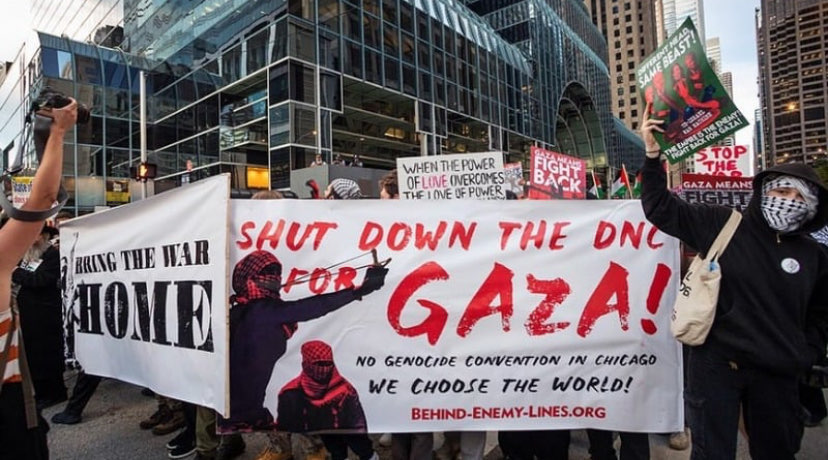
Behind Enemy Lines set out with one simple, yet ambitious goal: to shut down the DNC. For over 10 months, we, along with the rest of the world, watched in horror as the US-Israel war machine unleashed hell on Gaza. So when the party responsible for this carnage came to Chicago to appoint their next commander-in-genocide, we knew symbolic protest wouldn’t cut it. Nothing short of disrupting and shutting down the war machine’s party would do.
In the months leading up to the DNC, Behind Enemy Lines hit the streets of Chicago, speaking with people about what the DNC really represented and why we had to shut it down. We put out a call to action to join us before and throughout the DNC, in the fight against this celebration of genocidaires and US imperialism, to stand with the people of the world. The week before the DNC, we spent every day hitting the pavement with street teams, hosting educational events, leading trainings, and holding a day of city-wide speak-outs. When the DNC was in town, it was finally time to confront the war mongers head-on. No more pageantry. No more parades. On August 20th, we held the “Make it Great Like ’68” protest: a bold attempt to shut down the DNC for Gaza. Over 200 brave protesters joined us in front of the Israeli Consulate. But we were not alone. We were joined by hundreds of journalists and hundreds, if not a thousand, pigs, helmets on and batons at the ready1 .
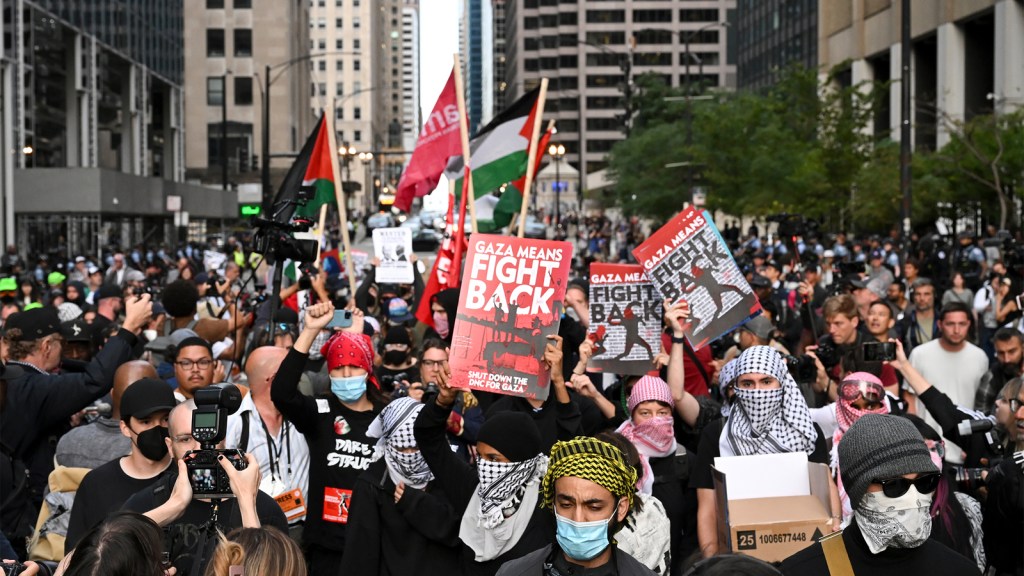
Protesters righteously tried to march towards the convention center, to confront those responsible for the genocide, but from the jump, it was clear: the City of Chicago, under Brandon Johnson’s command, had no intention of letting the protest carry on. After an initial wave of arrests, the crowd, unable to move forward, regrouped in front of the consulate, where people spoke bitterness about the atrocities of the US empire and burned a US-Israeli flag. When the crowd tried to leave, mass arrests followed — protesters were attacked with batons, kettled by the militarized police force, and given no opportunity to disperse.
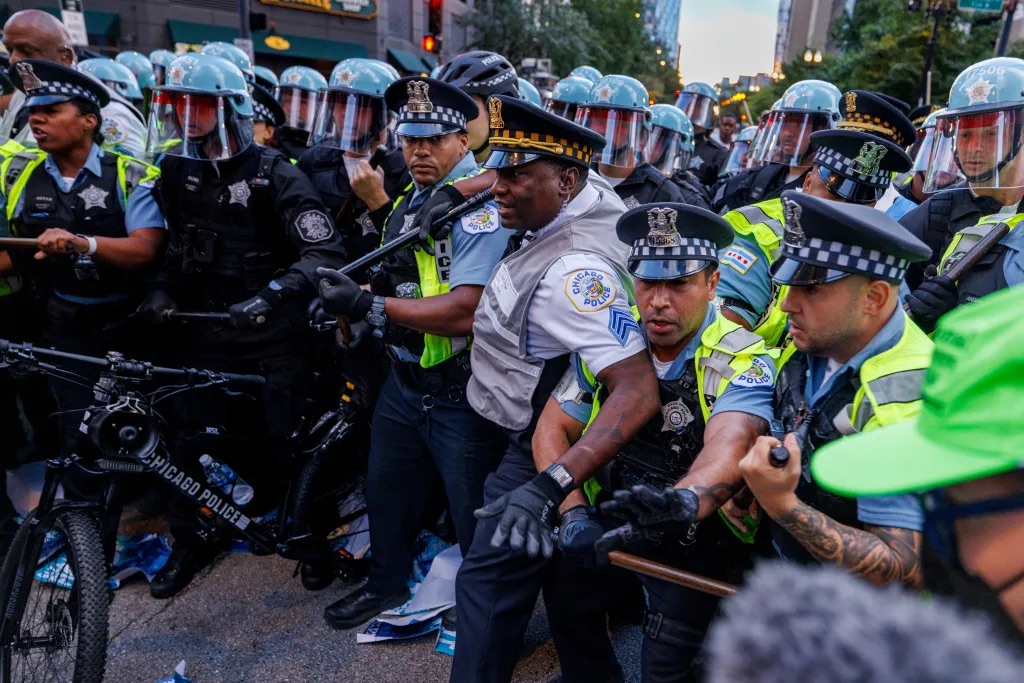
Over 60 people were arrested that night. The vast majority were hit with petty city ordinance charges like “failure to disperse” and “disorderly conduct.” Typically, those offenses just warrant a ticket, but everyone arrested was taken to jail, where protesters were held anywhere from 7 to 23 hours. As soon as the arrests began, BEL gathered outside of 2452 W Belmont Ave, where protesters were being taken to, ensured those arrested got connected to the Chicago chapter of the National Lawyers Guild (NLG) for legal assistance, provided jail support until every protestor was released.
Following our 8/20 protest, Chicago’s Mayor, Brandon Johnson, and Police Superintendent, Larry Snelling, had the audacity to call the DNC an “overwhelming success” and a shining example of “constitutional policing.” The media dutifully echoed this lie, pretending mass arrests and police violence were both justified and a sign of success. But Behind Enemy Lines saw through their bullshit, and we were ready to put up a fight. While the city celebrated this repression, we got to work, preparing to stand with those who caught charges, take the city to trial, and expose their so-called “success” for what it really was: a crackdown on dissent against those who wanted to put an end to a genocide.
Administrative punishment
The legal process that followed the DNC arrests was nothing short of a marathon of administrative hoopla. Most defendants had linked up with the National Lawyers Guild (NLG) for legal representation. The NLG’s Chicago chapter offers pro bono legal support to those arrested while exercising their First Amendment rights at protests and demonstrations. Most were facing misdemeanor charges, many of them just minor city ordinance violations. Regardless of the charges, having a lawyer was essential because navigating the countless court appearances and the jungle of legal jargon without one would’ve been near to impossible.
Defendants had to begin appearing in court as quickly as one week after the protest. Local defendants were expected to show up in person for every single appearance. Out-of-towners could request to appear via Zoom, though that privilege had to be granted by Judge Peter Gonzalez (who oversaw all of the cases), and was often threatened to be revoked if you were late, had a sliver of an attitude, or if the judge happened to skip his morning coffee. For nearly half the defendants, cases were dismissed right out of the gate because the arresting officer didn’t bother to show. One unlucky defendant whose charges were initially dropped after a cop no-showed had charges reinstated, only for the cop to ghost court again, resulting in the charges getting tossed once and for all. As for the rest? We buckled in for the long haul.
Being seen in front of the judge typically only lasted a minute or two, but defendants were expected to be in court promptly at 9 AM and wait their turn through the docket, sometimes being in court until 11 AM or 12 PM. The process was grueling; missing work, finding childcare, and securing transportation to the courthouse were responsibilities defendants had to navigate. “Status on discovery” stretched over multiple appearances, which basically meant the lawyers and prosecutors updated each other on what was happening with the so-called “evidence.” That dragged on for weeks, and in some instances, months, as the city dumped hundreds of hours of footage into the mix. Spoiler alert: it amounted to absolutely nothing. Most of it was irrelevant, and, to the city’s embarrassment, the body cam footage failed to substantiate the charges in the first place.
As the holidays rolled around, defendants had each been to court a number of times. Those who took plea deals most often received laughable “punishments”, like a $0 fine and supervision that was terminated that day (can you call a $0 fine and no supervision a punishment?), as long as they entered a plea of liable2. These “punishments” told us more about the City than the defendant who plead liable. Why pursue charges when you aren’t enforcing consequences? Is it because all these charges are bullshit in the first place, and the city is keen on punishing just resistance? Maybe Brandon Johnson can finally explain that the next time we run into him. Those who took deals had their reasons, and we respect that. But a committed group of defendants were ready to fight. In December, we began pushing for trial dates. If the city was going to pursue these charges, we were going to make them work for it.
For those who carried on, set on challenging the city and exposing these bogus charges, the grind continued. More hurry-up-and-wait court dates, more one-minute judge cameos. As we entered the new year, the remaining plea deals were finalized, and trial dates were finally being set. But, to no one’s surprise, the city, ever committed to wasting our time and money, started rescheduling trial dates, pushing that back into the spring. Sometimes they gave reasons, like needing to accommodate a cop’s schedule. Other times? Crickets. Out-of-town defendants were left to scramble for new travel and housing arrangements. After yet another round of rebooking, we finally locked in trial dates and were gearing up for our day in court. We were ready to face the city and win.
Drop the charges!
Outside of the Belmont and Western Jail on August 20th, the night of the protest, half a dozen people gathered for jail support, including a group of BEL members; we waited for the dozens of people who had been arrested. Restless, impatient, and starting to scratch the surface of summing up our attempt to shut down the DNC, the Drop the Charges Campaign was born. That night, in front of the Israeli consulate, we did not accomplish what we set out to do; the genocidal freaks partied on, uninterrupted. But we had mobilized hundreds of people who were sick of the business-as-usual protest bullshit. And the police? They rioted, exposing Chicago’s leadership for what it really was: not progressive, not “for the people,” and not remotely interested in standing with Palestine. When it came down to it, Brandon Johnson chose the side of genocide and turned his back on the people of the world. So we organized to challenge both the City and the State, demanding that all charges against DNC protesters be dropped, because it is right to rebel against genocide, and no one was wrong for confronting the DNC’s war machine. In building out DTC, it had three focuses: internally, working with defendants; externally, putting pressure on and exposing the city for repression and protecting the genociders, and finally, going to the masses.
In working with those who had been arrested, we attempted to contact as many people as possible to 1. Check in on how they were doing after getting tossed around by cops and spending a night in jail; 2. Ensure they were connected to NLG—or some sort of legal representation; 3. confirm their next court date; 4. Determine if they want to be a part of the political battle that Behind Enemy Lines was going to put up through Drop the Charges. For those who wanted in, we stuck with them until the end—whether their charges got dropped, they took a deal, or they went to trial. The legal system is a mess by design, and we made sure no one had to navigate it alone. We wanted people to feel supported, politicized, and ready to fight. Arrests were not a product of protesters doing anything wrong, but a product of the state wanting to repress resistance.
Once we had established our crew, roughly 25 defendants, the second part of our work kicked in: exposing the city and applying pressure. We launched a call-in campaign targeting Cook County State’s Attorney Kim Foxx and Chicago Mayor Brandon Johnson, demanding every single DNC protest charge be dropped. We showed up to the court on every appearance. At least one BEL member showed up to every hearing. For select dates, we rallied outside the courthouse, agitating around the absurdity of prosecuting protestors for opposing genocide. We chanted as the city’s legal team walked in, letting them know exactly who we were and that we weren’t backing down. Despite smaller turnouts, our presence didn’t go unnoticed. However, Brandon Johnson was still pursuing these charges, so we stepped it up. On October 7th, we crashed his press conference with one demand: Drop the charges. Then came the postcard campaign—filling his mailbox with that same demand. And finally, we held a people’s tribunal, publicly charging Mayor Brandon Johnson and Police Superintendent Larry Snelling with inciting a police riot. It was all part of pulling back the curtain and exposing the city and the mayor for who they truly are and what they actually stand for.
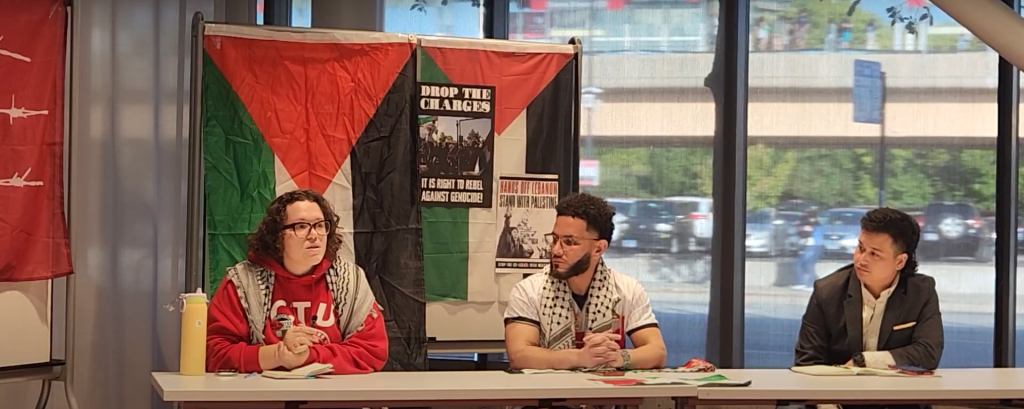
Finally, we took this campaign to the people. We hit the streets, talking to hundreds of people about the charges, handing out thousands of flyers and dozens of posters, and promoting our call-in and postcard campaigns. To extend our reach, we launched a “Drop the Charges Toolkit”, so anyone around the country had access to the flyers and posters to talk about this wave of repression. To those we spoke to, the response was overwhelming. People agreed: it was right to rebel against genocide, and these charges are ridiculous. Support came in many forms—some donated money, some put posters in their windows, and others joined us at courthouse rallies.
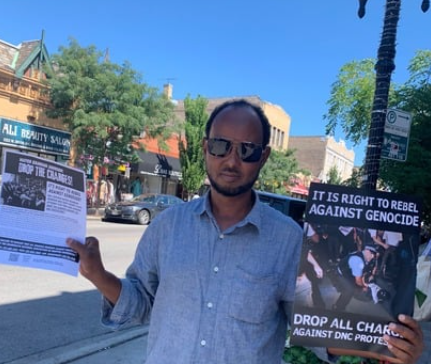
Thinking about the strengths of the Drop the Charges campaign—to start, it’s how fast it came together. DTC was born just hours after the mass arrests on 8/20, and by 8/21, we had already sent out our first street team. Hitting the ground immediately and orienting ourselves toward the masses allowed us to build support quickly, with the call-in campaign, putting up posters, and also financially. Consistent street teams were held in the weeks that followed that agitated around this repression and gave people tangible steps on how to support us.
Additionally, Behind Enemy Lines has long faced the criticisms that we don’t do jail support—and while that’s a bold face lie (several of us pulled an all-nighter at Western and Belmont), it actually doesn’t do justice to the extent of work that BEL went to in supporting defendants. Regardless of how they ended up with charges during the DNC, BEL had the back of anyone who wanted our support. Our political line is that it is right to rebel against genocide, and we must defend those facing repression. BEL members spent months checking in with defendants as they navigated the legal bullshit. For those who went to trial, it meant we helped cover the cost of flights and find lodging. And we were prepared to cover any fines that defendants got, but prosecutor Marianna Kiselev and the City couldn’t manage a victory to hold us to that promise. Having the backs of protesters, starting on 8/20 all the way through winning at trial, demonstrates how BEL stands on business when we talk about defending resistance. And in turn, 10 people took their cases to trial and won.
We also built a strong and responsive network of defendants. We stayed in touch with dozens of people as they navigated the chaos of city, and in some cases, state, charges. There was a deep sense of collectivity among those fighting back. This wasn’t just about beating individuals’ charges; it was about standing together in a broader movement against the growing wave of repression. And as the group began to understand the political purpose of these trials, we brought that forward to the National Lawyers Guild. That shift mattered. Lawyers often look for the quickest way to get charges dropped (understandably), but by pushing forward to trial with this political focus, we flipped the script—we were putting the city on trial. That kind of political focus wasn’t the norm for NLG, and it required defendants to stay unified and unwavering in their demand to fight.
In assessing the campaign’s shortcomings, first and foremost: we lacked legal know-how in the beginning. We were warned the process would be long, but we didn’t fully grasp just how long, or how complex, it would be. While we learned more throughout the process,(courtroom lingo, Judge Gonzalez’s routines, general procedural) not understanding the legal terrain early on likely cost us valuable time. Some charges were clearly heading to trial from the beginning, and failing to recognize that, and/or raising our political goals with lawyers sooner, delayed our ability to act decisively and prolonged these cases.
Coming off the DNC, we had a lot of momentum, plenty of attention, and curiosity about our work and membership. The Drop the Charges campaign was a great rallying point for our contacts locally and around the country, but we failed to bring many of those people into this work. We either lost touch or diverted energy into other recruitment efforts. As a result, turnout at rallies and pack the courts events remained small. Our mail-in campaign didn’t reach its full potential. While we did develop the DTC toolkit in hopes that others would take it out both in Chicago and nationally, without consistent follow-up, it never grew into the national campaign it could’ve been.
Finally, this summation should’ve come out in late spring, not late-summer. The political work doesn’t end when the campaign wraps; it ends with summation and sharing lessons learned. Sitting on this for too long limited its impact as talks of the DNC have faded and people’s focus have shifted towards other political topics. The insights from this campaign have great value, and it was a mistake to let them sit internally for so long.
A low low burden
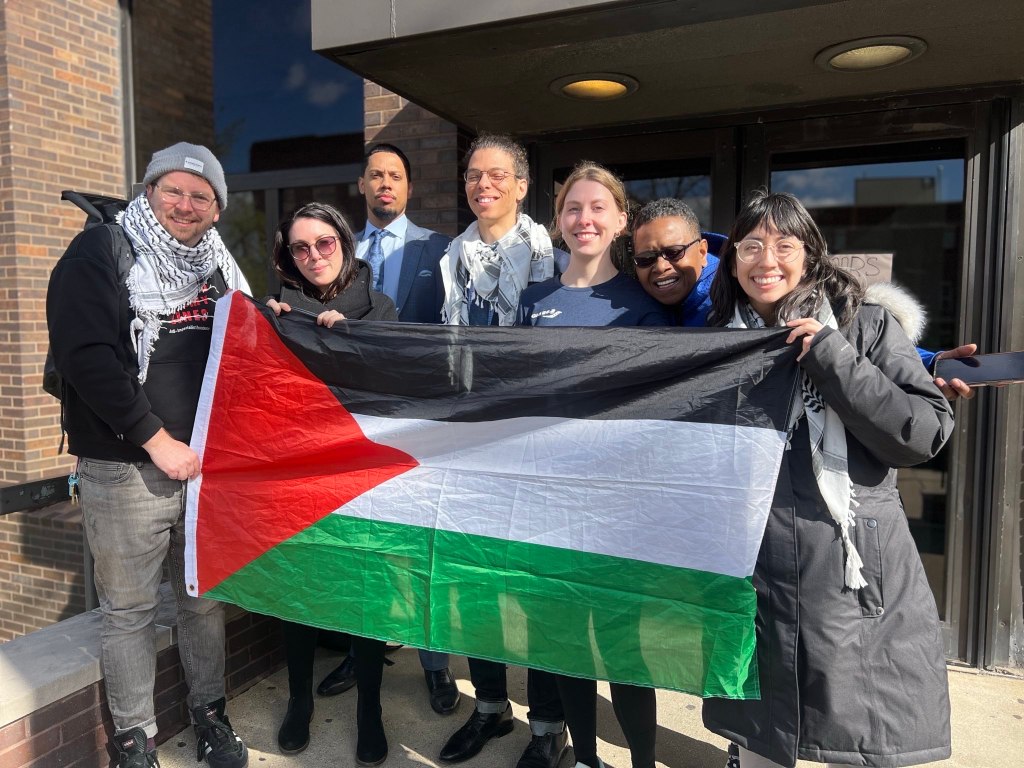
As the DNC cases slowly wound through the court system, BEL ended up with a group of 10 defendants who refused on principle to take any plea deals at all and demanded their day in court. This group of 10 ran the gamut from people who were longtime members of BEL, to people who took up our call to come to Chicago and join us in going to the people last August, to a few people who just showed up at the 8/20 protest because they hated the Gaza genocide. All 10 of them came together with BEL and a few courageous lawyers from the NLG to demand that the city of Chicago justify their repressive crackdown on the DNC protests, and prove the charges in court. All of these defendants either had to travel to Chicago for their trial date or take off work for yet another in-person court appearance. The defendants all faced the possibility of being found criminally liable and the possibility of monetary fines, community service, and court supervision.
We say liable and not guilty, because all 10 cases in Gonzalez’s courtroom were charges for city ordinance violations, which carry no potential jail time, and consequently a lower burden of proof for the city to prove its case: not the standard “beyond a reasonable doubt”, but a lower burden of “preponderance of evidence.” One of the many unanswered questions of this prosecution is why Brandon Johnson’s city law department pursued these cases so vigorously with so little to gain, especially once they began losing the cases. A trial in misdemeanor court is a particularly bizarre experience: it involves showing up to the 9 AM court call to affirm trial that day, then sitting through the entirety of the 9 AM court call, and then beginning the trial, only to pause the trial to wait through the entirety of the 1 PM court call, and finally finishing the trial and having the judge deliver a verdict.
The first of the DNC trials began with a comedy of errors for the city. Seemingly unaware of the First Amendment, city attorney Mariana Kiselev tried to have a defendant reprimanded in court for joining BEL in a protest outside the courthouse before the trial. During the trial, Kiselev was routinely chastised by Judge Gonzalez for failing to follow basic courtroom rules of evidence and attempting to lead her two police witnesses to give the answers she wanted. Meanwhile, volunteer NLG attorneys were able to expose the obvious lies that the police were telling.
In a pattern that would repeat itself over months of trials, all the city prosecutors could prove was that the defendant was at the protest (something self-evident by the fact that they were arrested at the protest). The city could find no evidence to prove that the first defendant (or subsequent defendants) had done anything wrong at all. The first case resolved with Judge Gonzalez admonishing city prosecutors for bringing the case forward at all, and city attorney Kiselev snapping at the Judge: “unbelievable”.
Kiselev and a few other city attorneys ran all of their failed prosecutions from the same playbook: they would subpoena the arresting officer to bumble their way through the story of how they arrested the defendant, but first, they would subpoena CPD Deputy Chief Chris Papaioannou. Papaioannou, with the white ethnic look and receding hairline straight out of central casting, was the third in command of the 8/20 police riot and responsible for giving the dispersal orders. Papaioannou, in his 25-year CPD career, has cost the city of Chicago $130,000 in lawsuits thanks to his 26 civilian allegations and 17 use-of-force complaints. Before any overtime, he brings in $183,984 a year.
Papaioannou was a less-than-impressive witness, both trying to paint a picture of an out-of-control crowd that refused lawful dispersal orders, and of a completely in-control police department. Kiselev and other city attorneys set up Papaioannou to try to describe unlawful acts that had occurred on 8/20, which boiled down to the protest not having a permit (which is not illegal) and protesters trying to march and being blocked by hundreds of CPD. Throughout the trials, neither Papaioannou nor the arresting officers could describe a single illegal act other than protesters being present at a protest, and apparently failing to disperse. During one trial, Papaioannou seemingly forgot how to tell time, being unable to chronologically describe a series of events. At another trial, the city, clearly scrambling to prove their case, set up a cop to testify about “feeling scared” of a defendant, prompting the Judge to tell him he wasn’t entirely honest. In the most charitable reading, the City’s witnesses were ineffective in proving their case. In a more realistic reading, they were actively lying on the wittness stand.
Much of the trial’s legalese focused on the issue of dispersal orders. While the NLG attorneys were generally prohibited from introducing evidence that the dispersal orders were not legal to begin with, they were able to expose that the city could not establish evidence that any individual protester had heard the dispersal orders. While generally uninterested in the constitutional issues, Judge Gonzalez did reject the argument that the city made that people lose all of their rights to protest once a single cop issues a dispersal order: it was clear from all the facts that protesters had in fact moved from the area of the Israeli Consulate and attempted to keep protesting in compliance with a dispersal order and that large numbers of people were attempting to disperse when they were arrested.
The bizarre logic of the city prosecutors boils down to an assertion that the CPD has the unilateral right to arrest any protester, at any time, based on arbitrary decision making, and that being in the vicinity of the protest that CPD has decided is no good in of itself constitutes disorderly conduct. That was the legal argument pursued by Brandon Johnson’s law department in their failed attempt to prosecute anti-genocide protesters.
In several cases, the city was only able to prove through video evidence and police testimony that the defendants were present at the protest, which again is self-evident. In others, they admitted that CPD targeted a demonstrator simply for carrying a large Palestinian flag, under the assumption that they were a protest leader (and a clear violation of the First Amendment). One defendant was arrested while standing on a sidewalk planter taking pictures, and another was personally ordered arrested by CPD Superintendent Larry Snelling for criticizing CPD officers during their mass arrest. In one case, the city could not even produce video of the defendant being arrested or even attempt to justify why they were arrested.
At the end of this process, Brandon Johnson and the city prosecutors picked up a rock to drop it on their own feet. With all of their resources, with the entire CPD and city law department at their disposal, the City of Chicago attorneys lost all 10 cases, to a crew of protesters who decided to take a stand on principle, by BEL who wouldn’t shut up about the repression, and by a wily group of volunteer attorneys who had the audacity to believe in the right to protest. Clever legal strategy, nonstop protests, and especially the courage of defendants who refused all deals exposed that city prosecutors had no legal basis to justify their arrests, and weren’t prepared to do so in a court.
Friends and enemies: on lawyers and the Left
We came through the DNC trials with a tremendous amount of respect for the attorneys of the National Lawyers Guild in Chicago. NLG volunteers were with us from the beginning, going toe to toe with Brandon Johnson’s CPD to visit arrestees while they were still in jail, and were able to represent each and every defendant who wanted their representation. Through the early stages of the court cases, NLG attorneys were able to get some charges dismissed by exposing that city prosecutors were trying to bend the court rules by presenting the wrong arresting officer as a “complaining witness”. The group of lawyers that went to trial with us and the 10 defendants never blinked at the amount of work required to dig through video and prepare for trial. It was obvious to everyone in the courtroom during the trials that not only was the defense side more just, but the volunteer attorneys were also better prepared and their arguments more legally sound than the paid city attorneys.
Despite the NLG attorneys having to play nice with the city prosecutors and the judge, they never asked us to slow down our protests or asked to change the tone of our writings, posts, or flyers, including our loud hostility towards Chicago Mayor Brandon Johnson. In fact, the NLG people we worked with emphasized the differences between legal and political strategy and made the point that the political strategy was up to us and the defendants to determine. With all of the respect in the world for those attorneys, we also have an obligation to sum up the problems and contradictions with the legal approach pursued in these cases.
Having gone through the entirety of the legal process with these cases, we now know that we should have both asked for and struggled for a much more aggressive legal approach from the first instances of these cases being called. While our NLG attorneys were willing to take cases to trial, their overall inclination was to argue for dismissal on procedural grounds or angle for a favorable plea bargain. While beyond the scope of this summation, it’s notable that the legal strategy of pursuing plea bargains in the majority of criminal cases is a key part of how defense attorneys have largely become cogs in the wheel of the mass incarceration machine. In the case of the DNC arrests, our own ignorance of the legal process and the standard practice of lawyers meant that we did not come into the first hearings swinging, and in fact didn’t get to actually take any legal swings until the cases went to trial.
While the attorneys were going through the standard practice of letting the cases proceed, hoping the charges would be dropped because the cops simply couldn’t show up for court (which happened in a number of cases), before moving through plea bargains and eventually trial, a strategy more in line with our overall view of the case would have involved the defense attorney’s arguing from the first court appearance for dismissal of the cases on first amendment grounds, and then demanding trial at each and every hearing until the case was dismissed or we got our trial date. While that practice certainly would have pissed off the judge (who was already grumpy) and the city prosecutors (which…fuck them), it also would have clearly drawn a legal and political line in the sand, and potentially saved months of bureaucratic wrangling.
We had also hoped to parallel the legal and political strategy by subpoenaing CPD Superintendent Larry Snelling, who personally supervised the 8/20 police riot, which none of the lawyers were willing to commit to, believing that he would not show up or the judge wouldn’t enforce the subpoena. While we believed that it still would have been beneficial to try and force the cases back into the media spotlight, the NLG attorneys were not willing to go there with us. Unfortunately, the radical legal tradition represented by Bill Kunstler and Lynn Stewart seems to be fading fast. We hope that our willingness to fight and our contact with a few radical attorneys can help in a small way relight the spark.
While we can squarely put the NLG attorneys in the “friend” camp, with some friendly criticism, the Left in Chicago utterly failed the assignment. After ignoring BEL during the lead up to the DNC or actively shittalking us online, many of Chicago’s Leftist scenesters appeared on the scene at Western and Belmont, turning “jail support” into a bizarre social hangout. Almost none of those people showed up at our people’s tribunal, to pack the court, at courthouse rallies, or street teams, or made a financial contribution to drop the charges. To put a sharper point on it (and yes, to do some score-settling) it’s bizarre and fucking gross the way people have turned “jail support”, which should simply consist of being there to greet people when they are released from jail to support them, get them a meal, and connect with them with transportation and legal support, into a hang out for dozens of people to post selfies from. At Western and Belmont, one 8/20 defendant who spent more than 20 hours in jail was greeted by one of these Leftists, less than an hour after being released, with criticisms about BEL and our political strategy. In the midst of the DNC political battle, Leftists in Chicago began spreading the lie that “BEL doesn’t do jail support”, despite the fact that we had a consistent presence outside of the jail up until the last defendant was released.
After the convention concluded, much of the established Chicago Left decided that, rather than supporting the DNC defendants, they would circle their wagons instead around Brandon Johnson, at the time when he was actively campaigning for Killer Kamala Harris. The Coalition to Carry Water for Brandon Johsnon March on the DNC put out a single self-serving statement on August 23, mainly intending to dismiss criticism of their own naked collaboration with CPD that did include the demand to drop all the charges on DNC protesters, without ever mentioning the 8/20 protest, Behind Enemy Lines, or Brandon Johnson by name. The Coalition and its main leaders did nothing else during this whole fight. This includes, true to its history, the “Chicago Alliance Against Racist and Political Repression”, who did not find the City of Chicago prosecuting anti-genocide protesters to be political repression and ignored the DNC prosecutions. On August 26, Jewish Voice for Peace Chicago shared an infographic that helpfully repeated BEL’s demands and calls to action, without ever making reference to BEL. Needless to say, they made no additional effort to join the campaign or even share our many and frequent updates.
The other group we can squarely put in the enemy camp (and if you haven’t figured it out by now, we think of the Left as an enemy) is the media. Hungry for sensational content, the media was present during the DNC protests and in the following 48 hours, happy to report on protest arrests, but had next to zero interest in following up on those arrests. A few journalists did decent follow-up work, covering the arrests of journalists during the DNC protests, but the major Chicago media outlets ran a single story at the end of the DNC trials. No major or independent outlets reported on our disruption of a major Brandon Johnson press conference or asked the mayor why his law department was pursuing these cases. We’re still waiting for a journalist or two to investigate how much money was spent by the city of Chicago pursuing these charges, or trying to find out who the ultimate decision maker was. To our knowledge, no journalist has found it pertinent to explore the contradiction between Johnson’s increasingly belligerent criticism of Donald Trump and his own Trumpian prosecutions at home.
Why any of this matters
Our experience fighting the DNC cases stands in stark contrast with common practice among people protesting for Palestine. Too many people have been indoctrinated in the Leftist obsession with safety and used that as an excuse not to fight back against repression. Way too many people who have caught charges have been pushed into taking plea deals, rather than standing and fighting in court and forcing the government to justify their repression. After a wave of police and university crackdowns on the campus encampments in spring ’24, campus activists were unable to respond to the new wave of bureaucratic punishment implemented in the fall of ’24. The US-Canada ban of Samidoun resulted in basically no protests, much less the wave of protests that could have reversed the ban.
Behind Enemy Lines and the DNC defendants were able to draw a firm line in the sand: we made it clear that the fight against repression is part and parcel of the fight for Palestine. That the courageous resisters were not going to be left to stand alone. We hope that this experience can inspire others to draw a line in the sand as well, one that is urgently needed. As we write this, the UK government has proscribed Palestine Action as a terrorist organization, an outrageous escalation that so far has not been met with protest in the US. Universities have cowed to the Trump government and are further cracking down on pro-Palestine speech and expression, while Trump’s ICE thugs have set their targets on students who have spoken out for Palestine.
The question facing everyone who is outraged about this repression is What are you going to do about it? We said we would fight, and we did.
– – –
Footnotes
1. For more on the 8/20 protest and our overall effort to shut down the DNC, see our Report Back from the Make it Great Like ’68 Protest at the DNC and “The DNC is that way!”: A summation of our fight to shut down the DNC for Gaza.
2. City ordinance violations carry no potential jail or prison time, and have a lower burden of proof for prosecutors to prove. Instead of being found or pleading guilty, those charged are either found (or plead) liable or not liable.
3. For more on the history of the National Alliance Against Racist and Political Repression and their failure to fight political repression, see Kick ’em While They’re Down, by the kites editorial committee.
 Behind Enemy Lines